First Aid Kit for High Mountains: What Equipment and Medication Should You Bring?
First aid kit for mountains like the Himalayas, Pamir, or Andes. What does it contain?
Anyone travelling in the Arctic or climbing in the high mountains faces a dilemma. On the one hand, staying properly hydrated is essential for survival, and the only available source of water is snow melted on a camping stove. On the other hand, cooking outdoors in severe cold and strong winds consumes enormous amounts of valuable fuel. The natural instinct, therefore, is to take shelter in a tent or snow cave and light the stove inside. Although this may seem like a comfortable solution, it carries a potentially fatal risk: poisoning from invisible carbon monoxide. Understanding this danger is essential for winter survival.
Carbon monoxide, also known as CO, is a product of incomplete combustion. Under ideal conditions, with an adequate supply of oxygen, gas or petrol burns completely, producing carbon dioxide (CO2) and water (H2O). However, such ideal combustion conditions are rare, if they occur at all. When the oxygen supply is limited, carbon monoxide (CO) is also produced during combustion. In winter conditions, when a shelter is small and poorly ventilated, its concentration can rapidly rise to dangerous levels.
Carbon monoxide is a colourless and odourless gas. These very characteristics make it so dangerous, as we cannot detect it with our senses. You will neither smell anything unusual nor see any smoke that might warn you of its presence.
Carbon monoxide literally “blocks” your blood. CO molecules have a much greater affinity for haemoglobin (the protein in red blood cells responsible for transporting oxygen) than oxygen itself. When you inhale carbon monoxide, it begins to take the place of oxygen in your bloodstream, forming a compound called carboxyhaemoglobin. Unfortunately, this compound is very stable, meaning that once haemoglobin binds with carbon monoxide, it can no longer perform its normal function of transporting oxygen. The more haemoglobin bound to carbon monoxide, the less oxygen your blood can carry. This leads to a gradual lack of oxygen in all tissues and organs, including the brain and heart. Your body begins to suffocate from within.
It is essential to recognise the symptoms of carbon monoxide poisoning and respond immediately.
Remember that in mountainous environments or during strenuous physical activity, these early symptoms — headaches and nausea — can easily be mistaken for fatigue or altitude sickness. This makes the danger even more insidious.
The combustion of fuel in a camping stove can be either safe (complete combustion) or dangerous (incomplete combustion). Incomplete combustion produces large amounts of carbon monoxide. You can, however, assess the combustion process by carefully observing the flame. The colour of the flame is the most important indicator of combustion quality.
| What to look for: | ✅ Safe Combustion | ❌ Dangerous Combustion |
| Flame colour | Uniform blue | Red, yellow or orange |
| Bottom of the cooking pot | Clean burner and cookware | Visible soot deposits on the pot and burner |
Research shows that all types of camping fuel — propane/isobutane gas canisters, white gas (camping petrol) and kerosene — can produce dangerous concentrations of CO in poorly ventilated spaces. Liquid fuels generally produce more carbon monoxide. However, the relationship is not quite that simple! Different stove models can produce different amounts of carbon monoxide even when burning the same fuel. Fuel type alone is not enough to determine how safe a stove is.
Field research has identified two stages of the cooking process that produce the largest spikes in carbon monoxide concentration:
Studies have also demonstrated that the technical condition of the burner is critically important. Lighting a burner covered in soot resulted in carbon monoxide levels increasing by as much as tenfold. Incomplete combustion caused by dirty or clogged burner jets is a major reason for a sudden increase in carbon monoxide emissions.
In a study conducted in north-eastern Greenland, researchers measured carbon monoxide levels while cooking in five different snow caves. They used an MSR WhisperLite liquid-fuel stove, priming it with ethanol before melting snow using white gas. I have used exactly the same system in the Arctic, for example, on Spitsbergen and during my Greenland traverse. There is just one difference: I use an MSR XGK stove.
What were the findings?
The authors concluded that although a single cooking session lasting less than 10 minutes may remain within safe limits, the stove priming process itself generates dangerously high short-term carbon monoxide exposure. They also confirmed that the condition of the burner is critically important. A dirty stove can emit up to ten times more toxic CO than a clean one.
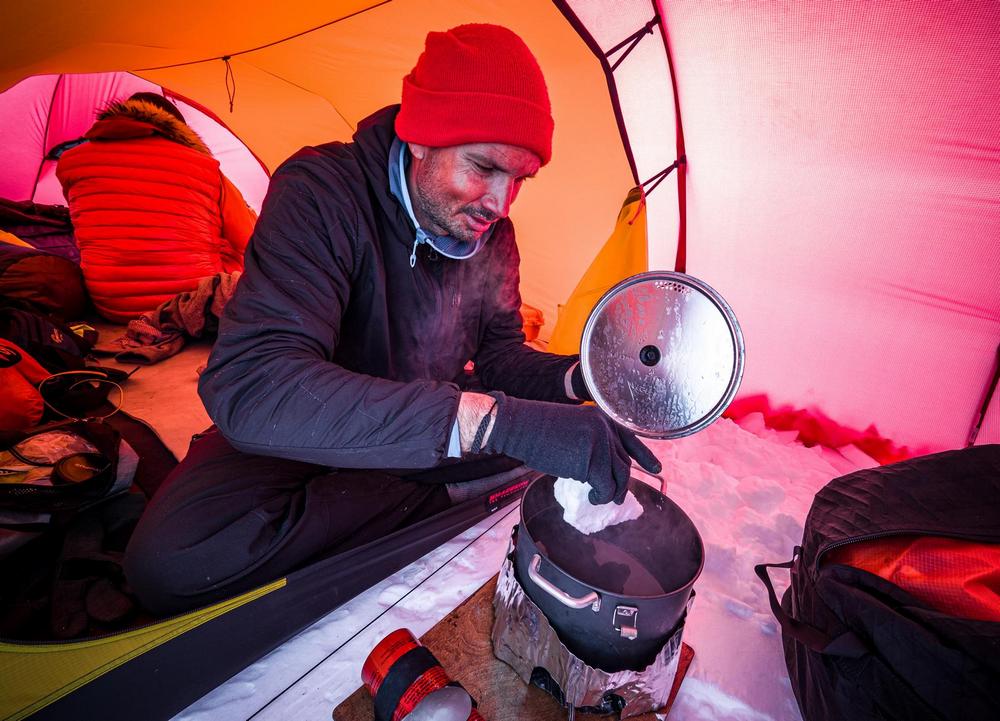
The choice of cookware can have a measurable effect on the amount of carbon monoxide produced. A larger pot diameter causes the flame to spread out, which in turn can lead to incomplete combustion. In a 2024 study, researchers compared a Coleman Dual Fuel 533 petrol stove using two pots: one with a base diameter of 16.5 cm and the other measuring 22 cm. The study, conducted under controlled laboratory conditions, confirmed that the larger pot produced higher carbon monoxide emissions.
In a study conducted in Greenland, researchers excavated five snow caves. They were built in a similar way, and each was equipped with ventilation openings with a cross-sectional area of 63 cm². This is equivalent to a circular opening approximately 9 cm in diameter — about the size of an average ski pole basket. Previous studies had considered openings of this size sufficient to keep CO concentrations below the safe threshold of 35 ppm (parts per million). However, in this experiment, this threshold was exceeded in 10 out of 16 trials. This demonstrates that even apparently adequate ventilation does not guarantee complete safety. Even if you build a snow cave correctly and provide ventilation, you cannot rely on ventilation alone.
In short, cutting a ventilation hole in the roof does not mean you can safely doze off while waiting for your water to boil. Constant vigilance is essential.
The risk of poisoning depends on both the concentration of carbon monoxide and the duration of exposure.
One experiment involved short cooking sessions (15–21 minutes) in a snow cave. The study showed that individual, short cooking sessions (lasting less than 10 minutes) may be tolerated in well-constructed snow shelters.
Another study involved a two-hour exposure inside a tent. Using a kerosene stove, researchers recorded elevated levels of carbon monoxide-bound haemoglobin in the blood of all study participants. These elevated levels were accompanied by a decrease in blood oxygen saturation (from an average of 98% to 95%) and an increase in heart rate. This indicates that the body was attempting to deliver oxygen to its tissues despite the developing oxygen deprivation.
The conclusion? The risk of severe poisoning increases dramatically as the operating time of a stove in an enclosed, poorly ventilated space becomes longer.

Climbing at high altitudes introduces additional risks. A study conducted at an altitude of 3,200 m above sea level demonstrated that even a single, brief exposure to CO while cooking inside a snow shelter increased carbon monoxide concentrations both in the air and in the blood of participants. Although no significant changes in vital signs or symptoms were observed, it is important to remember that even low levels of carbon monoxide can aggravate the symptoms of altitude sickness.
Now let’s turn these findings into simple, practical rules that could save your life.
Remember these eight rules whenever you consider cooking inside an enclosed shelter:
Carbon monoxide in a tent or snow cave is a real and potentially fatal danger. This is not, however, a reason to panic, but rather a reason to develop good habits. You need to be aware of the risks. You need to maintain your equipment. And, finally, you must follow safety rules without exception to minimise the danger. With this knowledge, you can make informed decisions that will help keep you safe when camping in winter, in the Arctic or at high altitude.
References:
1. Nielsen SU, Karlsen A. “A Field Study of Carbon Monoxide Levels in Snow Caves During Short-Term Stove Use”. Wilderness & Environmental Medicine. June 2024; 35(2): 129–137. doi: 10.1177/10806032241230241
2. Thurman JT, Leavitt R, Buchanan JT, Shreffler J, Huecker MR, Early T. “Carbon Monoxide Levels Produced by Propane/Isobutane Canister Stoves inside a Tent”. Wilderness & Environmental Medicine. December 2023; 34(4): 513–516. doi: 10.1016/j.wem.2023.06.006
3. Keyes LE, Hamilton RS, Rose JS. “Carbon monoxide exposure from cooking in snow caves at high altitude”. Wilderness & Environmental Medicine. Autumn 2001; 12(3): 208–212. doi: 10.1580/1080-6032(2001)012[0208:cmefci]2.0.co;2
4. Thomassen Ø, Brattebø G, Rostrup M. “Carbon monoxide poisoning while using a small cooking stove in a tent”. American Journal of Emergency Medicine. May 2004; 22(3): 204–206. doi: 10.1016/j.ajem.2004.02.011
5. Leigh-Smith S, Watt I, McFadyen A, Grant S. “Comparison of carbon monoxide levels during heating of ice and water to boiling point with a camping stove”. Wilderness & Environmental Medicine. Autumn 2004; 15(3): 164–170. doi: 10.1580/1080-6032(2004)15[164:cocmld]2.0.co;2
6. Leigh-Smith S, Stevenson R, Watt M, Watt I, McFadyen A, Grant S. “Does pan diameter influence carbon monoxide levels during heating of water to boiling point with a camping stove?”. Wilderness & Environmental Medicine. Autumn 2004; 15(3): 171–174. doi: 10.1580/1080-6032(2004)15[171:dpdicm]2.0.co;2
First aid kit for mountains like the Himalayas, Pamir, or Andes. What does it contain?

My first aid kit for the mountains or travel

How can you plan your route up the mountain before the expedition?